
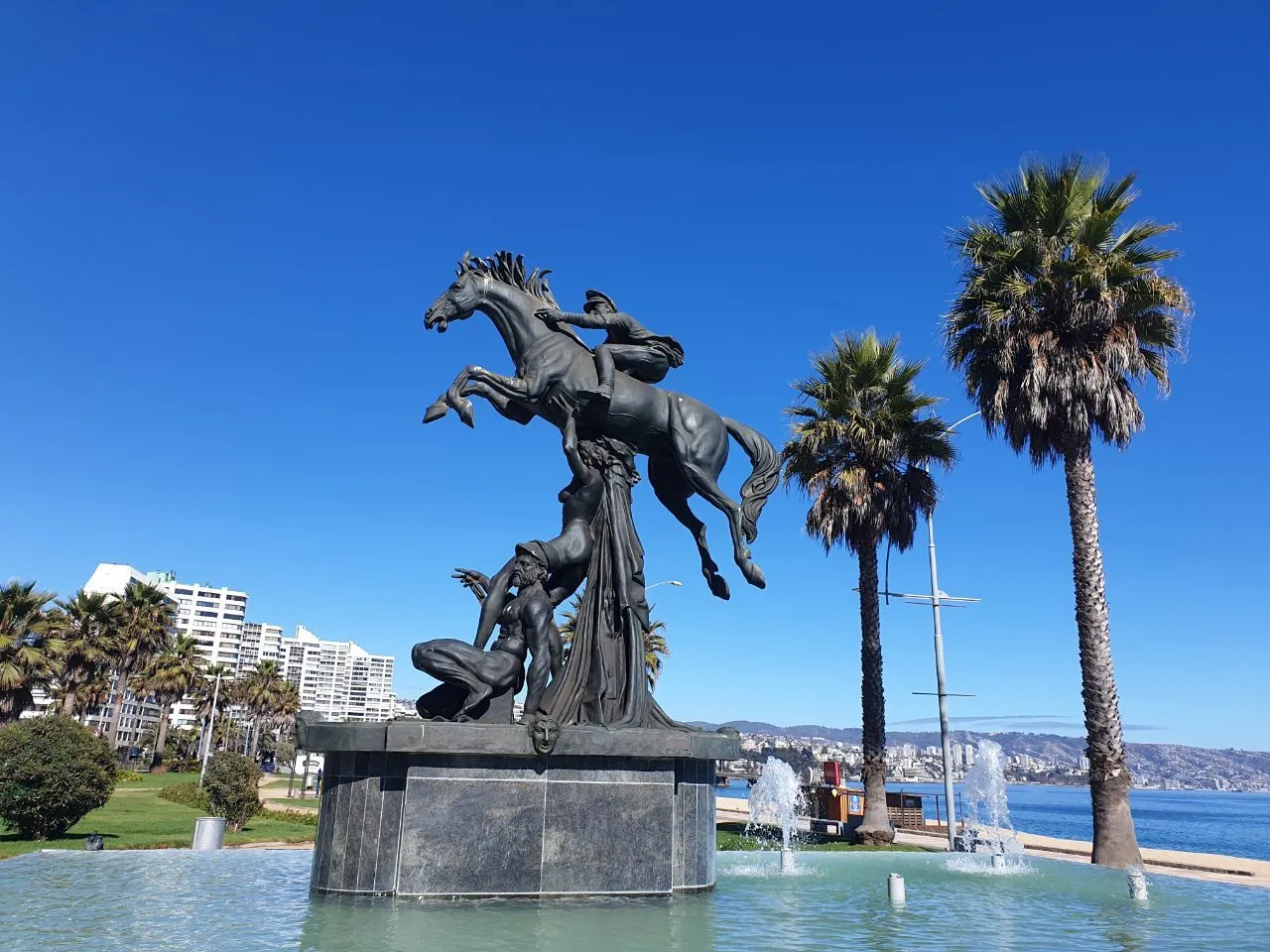
It's amazing how you can overlook interesting objects in places you visit frequently. I've been strolling along the waterfront of Viña del Mar for two years now, and only now did I notice an unusual monument. A horse with a rider soaring over a naked woman and a warrior lying at her feet.
I would have passed by, muttering something about tastelessness and a sick imagination if it weren't for one detail. The lower tier with the naked beauty and warrior clearly refers to ancient Greek heroics and mythology, while the rider is dressed in a military uniform that can be dated back to the early 20th century. Intrigued, I went to look for the plaque with the description. I found the plaque and it sent me on a journey through the expanses of the internet for a couple of hours.
The rider is Alberto, a Chilean officer who set a world record for the highest horse jump in 1949, a record that no one has been able to beat to this day. And it happened right here in Viña del Mar.
But the real hero of the record is undoubtedly the incredible horse Hueso with an absolutely amazing destiny. He changed names, sports disciplines, owners, and riders. Once he bolted from the pen and leaped over a two-meter fence. This event led to the idea of training him for high jumps. Eventually, that rider - Captain Alberto - began preparing Hueso specifically for the world record. Overall, there are many questions about how horses are treated by humans and training methods. And a big question, did Hueso want to set world records? But I didn't find any information about cruel treatment of the horse. Perhaps, as the press beautifully wrote in those years, it was indeed the result of cooperation and trust between the animal and the human.
In the end, Hueso jumped 2.47 meters. And here's what Alberto himself wrote about it:
"In the second jump, I must have made a mistake of about a centimeter because Huaso passed with his front legs, but hit the obstacle with his belly and knocked it down... only the third and last attempt remained. I counted everything again, and at that very moment, when we took off... The most difficult moment was the peak of the jump. My eyes were about 4 meters above the ground, and I felt like we were falling headfirst. Huaso would have felt even the slightest tremor from me and we would have crashed together. It seemed like that moment lasted forever. I didn't hear any cries and thought something had gone wrong, but I didn't hear any obstacles falling..."
After that jump, Hueso retired with honor. No riders ever rode him again, and he peacefully lived for another 12 years.
The horse and his record left a mark on Chile's literary scene. Several authors dedicated their books to him or included him in their plots. For example, Sergio Gomez has a book in his series of detective novels for teenagers titled "Quique Hache y el caballo fantasma" (Quique Hache and the Ghost Horse).
P.S.: About the horse's name
At first, the horse was named Faithful, but then renamed Hueso. At first, I couldn't understand what it meant. But that evening, I opened a book about Chilean slang at my friends' place and stumbled upon the word Hueso. It turns out, that's what Chilean cowboys are called. Unlike what we're used to seeing in westerns, their image is characterized by the presence of a poncho and a hat with flat brims. And I've even encountered them several times in the south, where Hueso dress like that not for show, but because that's how they look in real life.